Seamless pipe stock for sale: what to check before you buy surplus pipe
Seamless pipe stock for sale from checked sellers: API 5L, ASTM A106, A312 and EN 10216 pipe. Sizes, schedules, certificates and how to buy surplus pipe safely.
Seamless pipe stock for sale, surplus pipe, API 5L pipe stock, ASTM A106 Grade B, seamless carbon steel pipe, stainless seamless pipe, boiler tubes, pipe surplus project
Pipe is ordered in large quantities for projects — and projects change. That is why there is always seamless pipe stock for sale on the secondary market: project surplus, stockholder overstock and material from cancelled or completed jobs. For buyers who need pipe quickly, surplus stock can save weeks of mill lead time.
This guide explains the standards and checks that matter when you buy seamless pipe from stock.
Common seamless pipe standards
Standard
Material
Typical use
API 5L Gr. B / X42–X70
Carbon steel line pipe
Oil, gas and water pipelines
ASTM A106 Gr. B
Carbon steel
High-temperature process piping
ASTM A53 Gr. B
Carbon steel
General and structural piping
EN 10216-2 (P235GH, P265GH)
Carbon steel for pressure purposes
Boilers, pressure equipment
ASTM A192 / A210
Carbon steel boiler tubes
Boilers and heat exchangers
ASTM A312 (TP304L, TP316L)
Stainless steel
Chemical, food and pharmaceutical piping
Many carbon steel pipes are dual or triple certified (for example API 5L / ASTM A106 / A53), which widens their use.
Sizes, schedules and lengths
Size — nominal pipe size (NPS, in inches) or outside diameter in mm, for example 6″ = 168.3 mm OD.
Wall thickness — expressed as a schedule (SCH 40, SCH 80, XS) or in mm.
Lengths — single random lengths (around 6 m) or double random lengths (around 12 m).
Ends — plain or bevelled for welding; capped for protection.
Coating — black, varnished, galvanised or externally coated for pipelines.
What to check before you buy surplus pipe
Mill test certificates (EN 10204 3.1) with heat numbers, and matching stencil markings on the pipe.
Standard, grade and product specification level (for line pipe: PSL1 or PSL2).
Dimensions and tolerances — OD, wall thickness, ovality, length.
Storage condition — pipe stored outdoors for a long time can show internal or external corrosion. Ask for photos of the pipe ends and the inside.
End caps and coating — intact or damaged?
Quantity — tonnes and metres, number of lengths, and minimum order if sold per tonne.
Delivery terms — Incoterms, loading, transport by truck or container.
Inspection — for large or critical lots, an independent third-party inspection before shipment.
How surplus pipe is priced
Seamless pipe from stock is usually priced per tonne or per metre, sometimes as one price for the whole lot. Compare with current mill prices for the same standard and size, and value the availability: a pipe that can be loaded this week may be worth more to your project than a cheaper mill order with a long lead time.
Buying seamless pipe stock on Longshore
Longshore lists seamless pipe, tubes and fittings with real prices, quantities, stock locations and photos.
Checked sellers — company register, VAT number, sanctions lists and ownership are checked before a lot is published.
Order what you need — request the whole lot, order per tonne or per metre above the minimum quantity, or make an offer where bids are accepted.
Introduced, not exposed — Longshore checks your request and introduces you to the seller; the deal is closed with a proforma invoice, and you pay the seller directly.
Worldwide stock — from Europe, the Middle East, Asia and the Americas, in the currency of the lot.
Have surplus pipe yourself? List it on Longshore — free, screened, and with a commission only when a deal is closed.
Buy surplus stainless steel plate, sheet, coil and bar at real prices from checked sellers. Grades, finishes, certificates and what to check before you buy.
buy surplus stainless steel, stainless steel stock for sale, surplus stainless plate, stainless coil for sale, 316L plate, 304 sheet, duplex 2205, stainless steel offcuts
Surplus stainless steel is one of the most interesting materials on the industrial secondary market. Projects are cancelled or redesigned, stockholders over-order, fabricators finish a job with plate left over — and good, certified material ends up in a warehouse waiting for a buyer. For buyers, that means stainless steel stock with short delivery times and prices that are often below a new mill order.
This guide explains what to look for when you buy surplus stainless steel, and how to do it safely.
Where surplus stainless steel comes from
Cancelled or modified projects — plate, pipe and fittings ordered for a plant, tank or vessel that was never built.
Stockholder and distributor overstock — coils, sheets and bars in sizes that move slowly.
Fabrication leftovers — full plates and large offcuts after a job is finished.
Site closures — material in stock at a plant that stops production.
In most cases this is prime material, never used, with the original mill certificates. That is very different from scrap.
Grades you will find most often
Grade (EN / AISI)
Typical use
1.4301 / 304 and 1.4307 / 304L
General purpose: food, beverage, architecture, tanks
1.4404 / 316L
Chemical, pharmaceutical, marine and process equipment
1.4571 / 316Ti
Higher-temperature process applications
1.4462 / Duplex 2205
Strength and chloride resistance: offshore, desalination, chemical tanks
1.4016 / 430
Ferritic grade for appliances and decorative uses
Always check the exact grade on the certificate — 304 and 316L look identical on the warehouse floor.
Forms and finishes
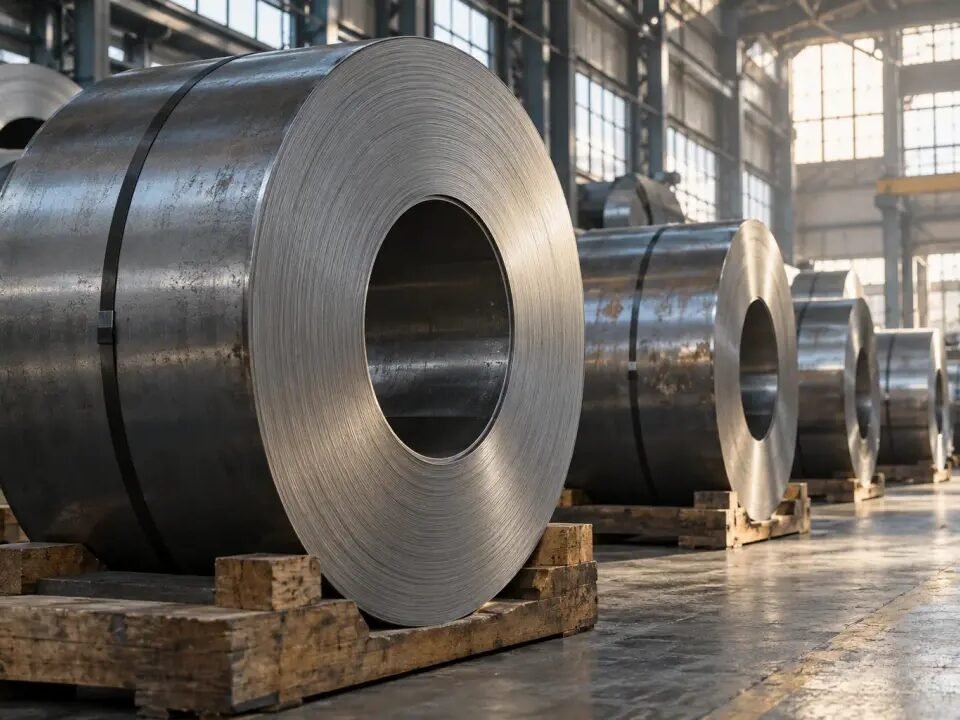
Coil — cold-rolled coils, usually 2B finish, sold per tonne.
Sheet — cut-to-length sheets in standard formats (for example 1000 x 2000 or 1500 x 3000 mm).
Plate — hot-rolled quarto plate in thicker gauges, No.1 finish.
Bar and profiles — round bar, flat bar, angles.
Finishes — 2B (cold-rolled, matt), BA (bright annealed), No.1 (hot-rolled, pickled), brushed or polished.
What to check before you buy surplus stainless steel
Certificates. Ask for the mill certificate (EN 10204 3.1) with heat numbers, and check that the markings on the material match.
Standard and dimensions. EN 10088-2 or ASTM A240, thickness, width, length, tolerances.
Condition. Protective film intact? Signs of corrosion from carbon-steel contact, scratches, edge damage, water marks inside coils?
Recent photos. Of the actual lot — including the markings and the packaging.
Quantity and minimum order. Whole lot, or per tonne with a minimum quantity?
Delivery terms. Incoterms (EXW, FCA, FOB, DAP), loading, and who arranges transport.
Inspection. For large lots, an independent inspection before shipment is worth its cost.
How prices work
Surplus stainless steel is usually priced per tonne for coil, plate and sheet, per piece or per metre for bar and pipe, or as one price for the whole lot. Stainless prices move with nickel and alloy surcharges, so compare a surplus offer with current market levels for the same grade and form — and remember that immediate availability has value of its own when a mill quotes weeks or months.
Buying surplus stainless steel on Longshore
On Longshore, surplus stainless steel and other industrial materials are listed with real prices, quantities, locations and photos.
Every seller is checked before a lot goes live: company register, VAT number, sanctions lists and ownership.
Buy the way that suits you — request the whole lot, order a quantity per tonne or per piece, or make an offer where the seller accepts bids.
Your request is checked and introduced. Longshore checks the buyer and introduces both parties; the deal is closed with a proforma invoice and payment goes directly to the seller.
Worldwide. Lots are listed in EUR, USD, GBP, CHF or AED, from stock locations in Europe and beyond.
Looking for a specific grade or size that is not listed? Contact Longshore — new lots are added after screening.
Surplus excess and obsolete industrial stock costs 20–30% of its value every year. How to calculate it, and how to sell idle materials and equipment.
All about: surplus inventory, excess stock, obsolete inventory, dead stock, industrial surplus, sell surplus steel, asset recovery, carrying cost, inventory write-off, working capital
Every plant, distributor and engineering contractor has it: surplus inventory that nobody plans to use. Stainless steel plate left over from a cancelled project. Valves and pumps bought for a plant extension that never happened. Motors in original crates, pipe in the yard, cable on drums, spare parts for a line that was shut down years ago. It sits on the balance sheet, it sits in the warehouse — and it costs money every single day.
This article explains the economics of excess and obsolete industrial stock, why “keeping it just in case” is usually the most expensive option, and how to sell surplus materials and equipment at a real price to checked buyers.
What surplus inventory really costs
Industrial companies tend to see idle stock as “already paid for”. Accountants see it differently. Holding inventory has a carrying cost — storage space, insurance, handling, counting, depreciation, the risk of damage and obsolescence, and the capital that is tied up and cannot be used elsewhere.
How large is that cost? A widely used rule of thumb is that carrying costs typically represent 20–30% of inventory value per year. There is no single official benchmark — the Institute for Supply Management notes there is no consensus figure, and most companies aim to keep it between 20 and 30 percent — but the order of magnitude is clear: roughly a quarter of the value, every year.
A simple example
Item
Value
Surplus stock on the books
€200,000
Carrying cost at 25% per year
€50,000 per year
After two years of “just in case”
€100,000 spent on keeping it
In other words: after four years, the company has paid as much to keep the stock as the stock was worth. And industrial surplus rarely gains value while it waits. Specifications change, certificates age, packaging deteriorates, and the market price of the material moves on.
Excess, obsolete or dead stock: know what you have
Not all idle inventory is the same, and the right selling strategy depends on the type:
Excess stock — good, current material in larger quantities than you need: steel plate, pipe, fittings, fasteners, cable. Often sellable close to market price, per tonne, per metre or per piece.
Project surplus — unused equipment and materials from cancelled or completed projects: pumps, valves, motors, heat exchangers, generator sets. Usually new and certified, and attractive to buyers who need short delivery times.
Obsolete inventory — spare parts and components for equipment you no longer run. Worthless to you, but often valuable to another plant that still operates the same machines.
Used and refurbished equipment — machine tools, press brakes, compressors, process equipment from closed or modernised sites.
Only true dead stock — damaged, unidentifiable or uncertified material — belongs in the scrap container. Everything else has a buyer somewhere. The question is how to reach that buyer.
Why industrial surplus often stays unsold
Most companies do not lack goodwill to sell; they lack a practical route:
Scrap value is the easy answer. A scrap dealer pays by weight and collects tomorrow. A stainless valve sold as scrap may fetch a small fraction of what a buyer who needs that valve would pay.
General marketplaces do not fit industrial goods. Consumer platforms are full of private sellers, unclear specifications and price negotiations without context. Industrial buyers want material grades, standards, certificates and Incoterms.
Nobody owns the job. Selling surplus is nobody’s main task. It falls between purchasing, maintenance, finance and the warehouse — and so it waits.
Trust. Sellers fear time-wasters and fraud; buyers fear that the goods do not exist or do not match the description.
How to sell surplus materials and equipment: five steps
Make a list. Item, material or grade, quantity, condition, location, certificates. A simple spreadsheet is enough to start.
Photograph the actual goods. Recent, sharp photos in good light — the whole lot, a close-up, the nameplate or marking, the certificates. Photos sell industrial surplus more than any description.
Set a real price. Buyers respond to prices. Decide whether you sell the whole lot or per unit (per piece, per tonne, per metre), and whether you are open to offers.
Reach checked buyers. Industrial buyers, distributors, traders and engineering companies — in your country and abroad.
Close properly. A proforma invoice with Incoterms, delivery time and payment terms; independent inspection for large lots; payment directly to the seller.
How Longshore works for sellers of industrial surplus
Longshore is a screened trading desk for industrial materials and equipment. It was built for exactly this problem: turning idle stock into a sale, with real prices and checked parties.
Free listing. You list materials, stock or equipment at no cost: steel and non-ferrous metals, pipes, tubes and fittings, valves, pumps and compressors, electrical equipment and motors, machinery and machine tools, forgings and castings, construction materials.
Three ways to sell. One price for the whole lot; a price per unit with a minimum order, so buyers order the quantity they need; or optional bids, where buyers make an offer and you accept, decline or counter.
Every seller and buyer is checked. Company register, VAT number, sanctions lists and ownership are checked before a lot goes live and before any introduction.
Your name stays private. Public listings show the goods, price, quantity and location — never your company name or contact details. Those are released only when a checked buyer is ready to proceed.
Worldwide, in your currency. Lots can be listed in EUR, USD, GBP, CHF or AED, from any location, for buyers anywhere.
Commission only on a closed deal. You pay nothing to list. A commission applies only when a deal is closed, agreed in writing before any buyer is introduced. The buyer pays you directly — never through Longshore.
How Longshore works for buyers
Industrial buyers use Longshore to find materials and equipment with short delivery times and transparent prices: surplus steel and stainless plate, seamless pipe, flanges, ball valves, centrifugal pumps, induction motors, generator sets, power cable and machinery. Buyers can request a whole lot, order a quantity per unit, or make an offer where the seller accepts bids. Every request is checked before it reaches the seller, and a deal becomes binding only with a signed proforma invoice.
The bottom line
Surplus inventory is not free. At a typical carrying cost of 20–30% of its value per year, keeping excess and obsolete industrial stock “just in case” is often the most expensive decision a company can make. Selling it — at a real price, to a checked buyer — turns a cost on the balance sheet into cash, frees warehouse space and working capital, and gives good material a second life instead of the scrap yard.
Have materials or equipment on your books that you no longer need? List them on Longshore — free, screened, and with a commission only when the deal is done.